

 BUSINESS UNITS
PRODUCTS
INNOVATION
SUSTAINABILITY
INVESTOR RELATIONS
CAREER
CONTACT
BUSINESS UNITS
PRODUCTS
INNOVATION
SUSTAINABILITY
INVESTOR RELATIONS
CAREER
CONTACT


We run all our operations in conformity with the corporate governance principles, transparency, fairness, responsibility and accountability.

Kordsa Code of Business Ethics and all relevant policies are reviewed and revised, if necessary, by the Ethics Board in line with recommendations received from the Global Ethics Compliance Officers, Global Legal and Compliance Department, and Local Ethics Compliance Officers. Once approved by the CEO of Kordsa, the update is announced to all employees.


Kordsa Code of Business Ethics and all relevant policies are reviewed and revised, if necessary, by the Ethics Board in line with recommendations received from the Global Ethics Compliance Officers, Global Legal and Compliance Department, and Local Ethics Compliance Officers. Once approved by the CEO of Kordsa, the update is announced to all employees.
The Global/Local Ethics Compliance Officers are responsible for informing employees about ethical standards and delivering training to ensure that the relevant policies and rules are understood and communicated regularly with employees. Once hired, all employees sign the Business Ethics Compliance Form stating that they have read and understood it and participate in the ethics survey at the end of each year. The ethics questionnaire includes questions that raise awareness and address the possible risks. New employees receive online and/or classroom training on ethics through a training platform supported with videos, cases, and questions. The Business Ethics Compliance Form serves as a risk assessment tool and is completed by each employee based on the ethical risks in their respective fields.

The Global/Local Ethics Compliance Officers are responsible for informing employees about ethical standards and delivering training to ensure that the relevant policies and rules are understood and communicated regularly with employees. Once hired, all employees sign the Business Ethics Compliance Form stating that they have read and understood it and participate in the ethics survey at the end of each year. The ethics questionnaire includes questions that raise awareness and address the possible risks. New employees receive online and/or classroom training on ethics through a training platform supported with videos, cases, and questions. The Business Ethics Compliance Form serves as a risk assessment tool and is completed by each employee based on the ethical risks in their respective fields.
Kordsa Executive Lead Team and Ethics Board are the central bodies responsible for implementing the Kordsa Code of Business Ethics. To manage this, an Ethics Compliance Officer is appointed to each site (Türkiye, Indonesia, Thailand, Brazil, USA). The Ethics Board comprises the Global Ethics Compliance Officer, Head of Legal and Compliance, Global Head of Human Resources, and Global Head of Internal Audit.

Kordsa Executive Lead Team and Ethics Board are the central bodies responsible for implementing the Kordsa Code of Business Ethics. To manage this, an Ethics Compliance Officer is appointed to each site (Türkiye, Indonesia, Thailand, Brazil, USA). The Ethics Board comprises the Global Ethics Compliance Officer, Head of Legal and Compliance, Global Head of Human Resources, and Global Head of Internal Audit.
Kordsa is committed to overseeing business in an ethically suitable manner. Kordsa Code of Business Ethics is the fund for trust for our employees, stakeholders, customers, suppliers, business partners, competitors, and society. It covers four main headings: legal obligations, integrity, confidentiality, and conflict of interest. While protecting the rights of beneficiaries, Kordsa, in all its operations and relationships, abides by the newly updated Kordsa Code of Business Ethics, approved by the Kordsa Board of Directors on September 21, 2021. The Kordsa Code of Business Ethics was initially developed by Hacı Ömer Sabancı Holding, and it has been refined in line with Kordsa’s practices. The document is available in the native languages of the countries we operate in (Turkish, English, Bahasa, Thai, and Portuguese) and is published on our website.

Kordsa is committed to overseeing business in an ethically suitable manner. Kordsa Code of Business Ethics is the fund for trust for our employees, stakeholders, customers, suppliers, business partners, competitors, and society. It covers four main headings: legal obligations, integrity, confidentiality, and conflict of interest. While protecting the rights of beneficiaries, Kordsa, in all its operations and relationships, abides by the newly updated Kordsa Code of Business Ethics, approved by the Kordsa Board of Directors on September 21, 2021. The Kordsa Code of Business Ethics was initially developed by Hacı Ömer Sabancı Holding, and it has been refined in line with Kordsa’s practices. The document is available in the native languages of the countries we operate in (Turkish, English, Bahasa, Thai, and Portuguese) and is published on our website.
 Kordsa Ethics Compliance Data 2025
 Information Text on Kordsa Teknik Tekstil A.Ş Supplier/ Business Partner Employees or Officials Personal Data Processing
Kordsa Statement on Code of Business Ethics
Kordsa Statement on Business Ethics Thai
Kordsa Statement on Business Ethics Indonesian
Kordsa Statement on Business Ethics Portuguese
Information Text on Kordsa Teknik Tekstil A.Ş Supplier/ Business Partner Employees or Officials Personal Data Processing
Kordsa Statement on Code of Business Ethics
Kordsa Statement on Business Ethics Thai
Kordsa Statement on Business Ethics Indonesian
Kordsa Statement on Business Ethics Portuguese

Since compliance with laws and regulations requires cooperation with our business partners, our relations with our business partners have an essential role in our compliance program. In this regard, the Kordsa Code of Business Ethics, which we expect our business partners to comply with, is implemented as a part of all our contracts, including but not limited to our general terms and conditions for sales and purchases. Likewise, we require our business partners to act according to the Kordsa Human Rights Policy as per our agreements with them.

Since compliance with laws and regulations requires cooperation with our business partners, our relations with our business partners have an essential role in our compliance program. In this regard, the Kordsa Code of Business Ethics, which we expect our business partners to comply with, is implemented as a part of all our contracts, including but not limited to our general terms and conditions for sales and purchases. Likewise, we require our business partners to act according to the Kordsa Human Rights Policy as per our agreements with them.
Being aware of our responsibilities against our competitors and stakeholders, we are committed to free and fair competition in compliance with all laws and regulations in force in relevant countries where we operate and attach great importance to compliance with competition laws.
In this regard, we have implemented the Kordsa Competition Law Policy, Kordsa Competition Law Compliance Guidelines, and secondary documents supporting compliance with competition law to ensure compliance with competition law in our activities and transactions. In addition, we provide competition law training to all our employees at least once a year.
Competition compliance is also closely monitored and given importance by our top management. In this context, to assess the awareness level of our employees on competition law and to proactively identify competition law risks, an annual Competition Compliance Assessment Report is prepared and shared with our top management by Global Legal and Compliance Department.

Being aware of our responsibilities against our competitors and stakeholders, we are committed to free and fair competition in compliance with all laws and regulations in force in relevant countries where we operate and attach great importance to compliance with competition laws.
In this regard, we have implemented the Kordsa Competition Law Policy, Kordsa Competition Law Compliance Guidelines, and secondary documents supporting compliance with competition law to ensure compliance with competition law in our activities and transactions. In addition, we provide competition law training to all our employees at least once a year.
Competition compliance is also closely monitored and given importance by our top management. In this context, to assess the awareness level of our employees on competition law and to proactively identify competition law risks, an annual Competition Compliance Assessment Report is prepared and shared with our top management by Global Legal and Compliance Department.
Operating in several countries, we attach great importance to compliance with complex trade sanctions and export control laws and regulations prohibiting importing, exporting, or re-exporting certain products to or from certain countries or parties. We ensure compliance with such sanctions and export controls following our internal policies and procedures designed in line with the policies and procedures issued by H.Ö. Sabancı Holding Inc. on sanctions and export controls.

Operating in several countries, we attach great importance to compliance with complex trade sanctions and export control laws and regulations prohibiting importing, exporting, or re-exporting certain products to or from certain countries or parties. We ensure compliance with such sanctions and export controls following our internal policies and procedures designed in line with the policies and procedures issued by H.Ö. Sabancı Holding Inc. on sanctions and export controls.
We carry out all necessary activities regarding compliance with the protection of personal data in the countries in which we operate, including but not limited to the Law on the Protection of Personal Data No. 6698 (“PDPL”) and secondary regulations.
Compliance with PDPL, secondary regulations, and other applicable data privacy laws is essential to Kordsa’s compliance activities. In this regard, the PDPL Committee continues to follow the best practices observed in the industry to keep up with the new developments, offer company‑wide guidance, and implement security measures in collaboration with the relevant departments.

We carry out all necessary activities regarding compliance with the protection of personal data in the countries in which we operate, including but not limited to the Law on the Protection of Personal Data No. 6698 (“PDPL”) and secondary regulations.
Compliance with PDPL, secondary regulations, and other applicable data privacy laws is essential to Kordsa’s compliance activities. In this regard, the PDPL Committee continues to follow the best practices observed in the industry to keep up with the new developments, offer company‑wide guidance, and implement security measures in collaboration with the relevant departments.
With the awareness that knowledge is one of the most valuable assets for our company and our stakeholders, Kordsa ensures the highest level of compliance with all applicable information security regulations and is proud to be the first company in our sector to be qualified for the ISO 27001 Information Security Management System certificate.

With the awareness that knowledge is one of the most valuable assets for our company and our stakeholders, Kordsa ensures the highest level of compliance with all applicable information security regulations and is proud to be the first company in our sector to be qualified for the ISO 27001 Information Security Management System certificate.
Anti-corruption is one of the ten fundamental principles of the UN Global Compact, which Kordsa committed to in 2014. We keep an equal distance from all public agencies and institutions, administrative bodies, non-governmental organizations, and political parties without expecting any benefits. We realize our obligations with this responsibility in mind while carrying out all our operations and transactions.
We comply with Article 3.5.2 of the Corporate Governance Principles that stipulates, “Corporation shall be sensitive to its social responsibilities and comply with the regulations and ethical rules regarding the environment, consumers, and public health. Corporation shall support, and respect internationally recognized human rights. Corporation shall fight against any kind of corruption including bribery.”
We published Kordsa Anti-Corruption and Anti-Bribery Policy in 2015 in line with the Turkish law. The policy also covers our business partners including sub-contractors, consultants, and lawyers. Our policy is communicated through our web site to all suppliers and other third parties we cooperate at different levels.
Communication and training sessions on anti-corruption in Kordsa cover all our employees per our Code of Business Ethics. The Ethics Committee and Internal Audit functions are responsible for communicating cases of corruption and unethical behavior, taking necessary action, and reporting such incidents to the Sabancı Holding Ethics Committee.
Our measurement and monitoring mechanisms include the Ethics Hotline and Internal Audit Department, Audit Committee, and audits at the Holding level. If a notification is made regarding corruption and/or bribery and a case is filed, the Internal Audit Department reports the case to the Audit Committee. There is no specific section regarding corruption and/or bribery in ethics reporting.
Prohibition of facilitation payments are openly prohibited on clause 6.4. of our policy. The employees cannot engage in any business relationship with family members, acquaintances or third persons that would result in mutual or unilateral benefits. They cannot generate income or enable others to do so by engaging in trade, including trading securities on the stock Exchange through insider information. The rules mandate that employees cannot manage an enterprise, neither directly nor indirectly, and that they cannot work for a third person and/or organization during or outside of working hours in return for a certain fee or comparable gain.

Our Board of Directors is responsible for ensuring that Kordsa’s operations comply with the legislation, the articles of association, internal regulations, and identified policies and for protecting the long-term interest of our company by way of the strategic decisions it takes.
Our annual report includes details on the structure of the Board, its working principles, members’ positions, internal and external commitments, responsibilities, and the terms of office. Committees composed of the Board Members are the Audit Committee, Corporate Governance Committee, and Early Risk Identification Committee.
Our Board of Directors consists of six members, one of whom is female (17%) and two are independent members. One independent member is the Chair of the Early Risk Identification Committee and a member of the Corporate Governance and Audit Committee. The second independent member is the chair of both the Corporate Governance and Audit Committee and a member of the Early Risk Identification Committee. All members, except for independent members, hold executive functions.

Our Board of Directors is responsible for ensuring that Kordsa’s operations comply with the legislation, the articles of association, internal regulations, and identified policies and for protecting the long-term interest of our company by way of the strategic decisions it takes.
Our annual report includes details on the structure of the Board, its working principles, members’ positions, internal and external commitments, responsibilities, and the terms of office. Committees composed of the Board Members are the Audit Committee, Corporate Governance Committee, and Early Risk Identification Committee.
Our Board of Directors consists of six members, one of whom is female (17%) and two are independent members. One independent member is the Chair of the Early Risk Identification Committee and a member of the Corporate Governance and Audit Committee. The second independent member is the chair of both the Corporate Governance and Audit Committee and a member of the Early Risk Identification Committee. All members, except for independent members, hold executive functions.
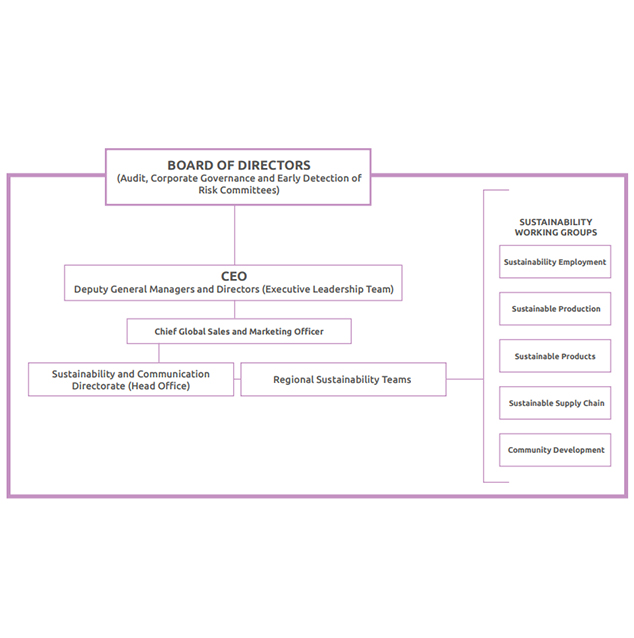
Our material sustainability topics and our sustainability targets against those topics are periodically reviewed within the company every two years. These targets are entrusted to the Kordsa Leadership Team which is composed of our CEO and Chief Officers, for periodic review and renewal as needed. Reporting to the Board of Directors, our CEO, in collaboration with the Kordsa Leadership Team, discerns critical environmental, social, and governance (ESG) issues, along with potential risks and opportunities. These insights culminate in the development of corresponding ESG policies, subject to the Board’s approval and subsequent public disclosure on our official website.
Located at the corporate headquarters, the Sustainability and Communication Directorate operates under the leadership of the Chief Global Sales and Marketing Officer as of 2022. Sustainability and Communication Directorate works in close harmony with both the Sustainability Working Groups and Regional Sustainability Teams spanning various countries. Its primary objective is to ensure coordination between departments and executive management to achieve the company’s objectives. Furthermore, the directorate is pivotal in executing sustainability-driven strategies across the organization.

Our material sustainability topics and our sustainability targets against those topics are periodically reviewed within the company every two years. These targets are entrusted to the Kordsa Leadership Team which is composed of our CEO and Chief Officers, for periodic review and renewal as needed. Reporting to the Board of Directors, our CEO, in collaboration with the Kordsa Leadership Team, discerns critical environmental, social, and governance (ESG) issues, along with potential risks and opportunities. These insights culminate in the development of corresponding ESG policies, subject to the Board’s approval and subsequent public disclosure on our official website.
Located at the corporate headquarters, the Sustainability and Communication Directorate operates under the leadership of the Chief Global Sales and Marketing Officer as of 2022. Sustainability and Communication Directorate works in close harmony with both the Sustainability Working Groups and Regional Sustainability Teams spanning various countries. Its primary objective is to ensure coordination between departments and executive management to achieve the company’s objectives. Furthermore, the directorate is pivotal in executing sustainability-driven strategies across the organization.
Regional Sustainability Teams diligently monitor the established performance indicators designed to actualize sustainability goals envisioned within our strategic plans. This oversight extends to meticulously tracking and executing projects devised to attain these objectives in collaboration with pertinent regional departments. These teams report site level sustainability performance indicators through the Quarterly Sustainability Performance Tracking Program. Quarterly sustainability performance tracking reports, comprised through the monitoring and evaluation of targets, are crafted by the Sustainability and Communication Directorate. The Kordsa Leadership Team orchestrates quarterly evaluations of our sustainability targets and roadmap. Sustainability Working Groups are responsible for devising roadmaps to realize sustainability targets and closely monitor and oversee the outlined action plans. Within this framework; Sustainable Employment, Sustainable Production, Sustainable Products, Sustainable Supply Chain, and Community Development working groups steadfastly pursued projects and initiatives aligned with their respective targets. In 2023, these groups reviewed performance indicators every three months in accordance with the principles that guide their functioning.

Regional Sustainability Teams diligently monitor the established performance indicators designed to actualize sustainability goals envisioned within our strategic plans. This oversight extends to meticulously tracking and executing projects devised to attain these objectives in collaboration with pertinent regional departments. These teams report site level sustainability performance indicators through the Quarterly Sustainability Performance Tracking Program. Quarterly sustainability performance tracking reports, comprised through the monitoring and evaluation of targets, are crafted by the Sustainability and Communication Directorate. The Kordsa Leadership Team orchestrates quarterly evaluations of our sustainability targets and roadmap. Sustainability Working Groups are responsible for devising roadmaps to realize sustainability targets and closely monitor and oversee the outlined action plans. Within this framework; Sustainable Employment, Sustainable Production, Sustainable Products, Sustainable Supply Chain, and Community Development working groups steadfastly pursued projects and initiatives aligned with their respective targets. In 2023, these groups reviewed performance indicators every three months in accordance with the principles that guide their functioning.
The Reporting Group is responsible for ensuring regular data collection and best practices in all company plants for the annual sustainability report. Reporting group representatives collect the information they requested beforehand according to the reporting criteria demanded from them, between February and March every year. The reporting group consists of representatives from different departments. These departments are Occupational Health and Safety, Environmental, the Energy Committee, Finance, Supply Chain, Human Resources, Legal, Market Development, Corporate Communications, R&D, Quality, and TPM. The reporting group also includes some Sustainability Leaders and Management Team Advisory Members.
The Corporate and Brand Communication Department who reports to the Corporate and Brand Communication & Sustainability Manager, works to raise awareness on sustainability through social responsibility projects, awareness events and trainings, as well as brand and communication activities.
At Kordsa, we create implementation and action plans in line with our short and long-term goals and make them public through our reports. We included the actions taken and their results within the scope of our first five-year sustainability roadmap in the 2019 Sustainability Report. As part of the new targets set in 2020, we have formed four new workgroups. In 2020, Employment and Human Rights, Business Ethics, Environment, and Sustainable Purchasing workgroups all started to design projects and programs to be carried out towards the new five-year goals.

The Reporting Group is responsible for ensuring regular data collection and best practices in all company plants for the annual sustainability report. Reporting group representatives collect the information they requested beforehand according to the reporting criteria demanded from them, between February and March every year. The reporting group consists of representatives from different departments. These departments are Occupational Health and Safety, Environmental, the Energy Committee, Finance, Supply Chain, Human Resources, Legal, Market Development, Corporate Communications, R&D, Quality, and TPM. The reporting group also includes some Sustainability Leaders and Management Team Advisory Members.
The Corporate and Brand Communication Department who reports to the Corporate and Brand Communication & Sustainability Manager, works to raise awareness on sustainability through social responsibility projects, awareness events and trainings, as well as brand and communication activities.
At Kordsa, we create implementation and action plans in line with our short and long-term goals and make them public through our reports. We included the actions taken and their results within the scope of our first five-year sustainability roadmap in the 2019 Sustainability Report. As part of the new targets set in 2020, we have formed four new workgroups. In 2020, Employment and Human Rights, Business Ethics, Environment, and Sustainable Purchasing workgroups all started to design projects and programs to be carried out towards the new five-year goals.
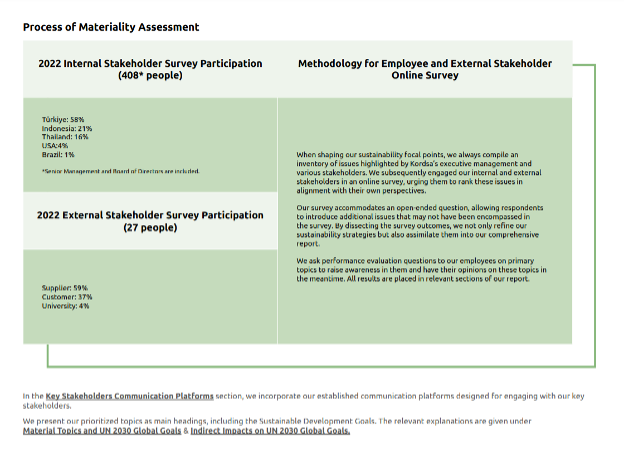
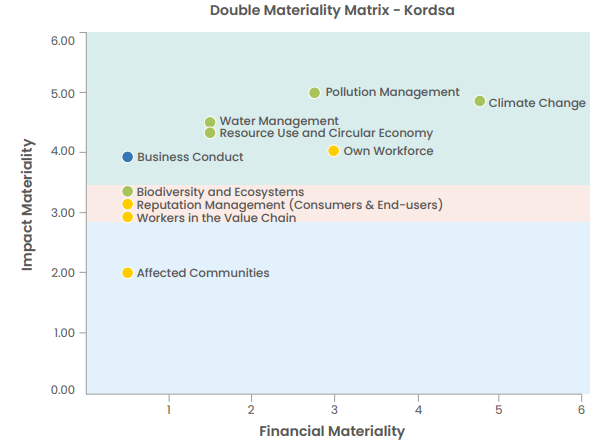
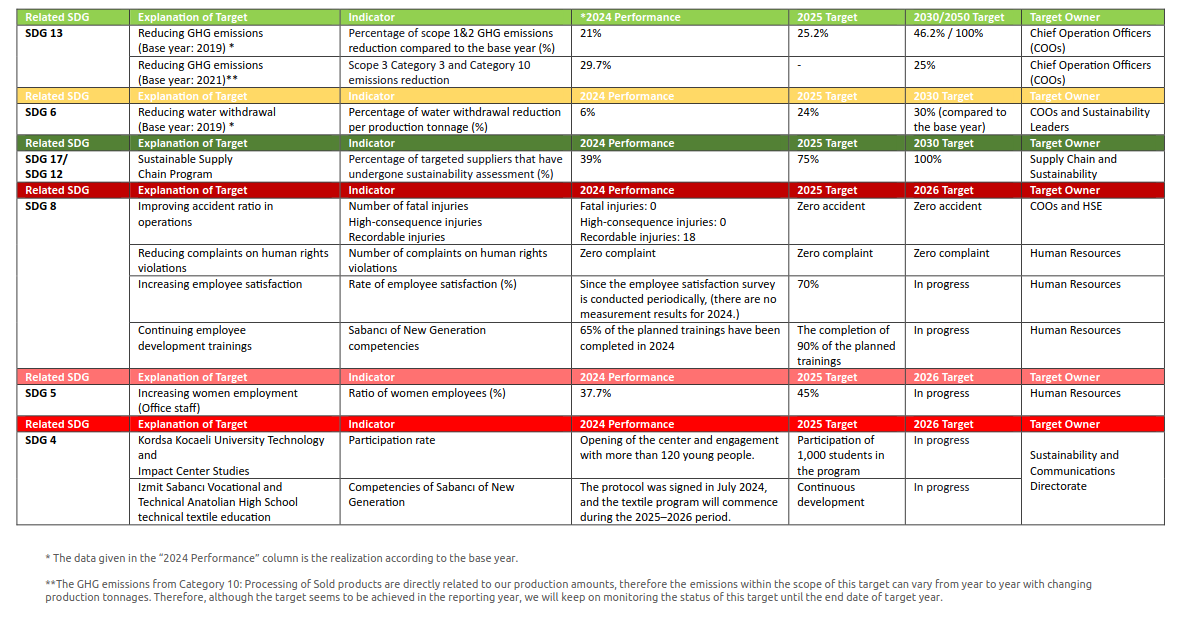
Considering the material sustainability topics that we identified at Kordsa; we prepared a five-year sustainability roadmap in the last quarter of 2016 which was approved by Kordsa Executive Leadership Team. Considering 2016 as the base year, we prepared all sustainability management actions up to 2020. We accomplished most of our targets by the end of 2019. We decided to include the target of ‘adding Scope 3 to emission calculation in all plants, which we could not complete in 2019, within 2020 activities. Our 2020 Scope 3 data is included in the Emission Management section. In the second quarter of 2020, we reviewed our strategic priorities and set new short, medium, and long- term sustainability goals based on the United Nations (UN) 2030 Sustainable Development Goals. After examining which UN sub-goals our company's activities serve, we decided to focus on five related goals; SDG 9: Industry, Innovation, and Infrastructure, SDG 12: Responsible Production and Consumption, SDG 8: Decent Work and Economic Growth, SDG 5: Gender Equality, and SDG 4: Quality Education. The sustainability targets we updated in the fourth quarter of 2020 is located here.
Considering the material sustainability topics that we identified at Kordsa; we prepared a five-year sustainability roadmap in the last quarter of 2016 which was approved by Kordsa Executive Leadership Team. Considering 2016 as the base year, we prepared all sustainability management actions up to 2020. We accomplished most of our targets by the end of 2019. We decided to include the target of ‘adding Scope 3 to emission calculation in all plants, which we could not complete in 2019, within 2020 activities. Our 2020 Scope 3 data is included in the Emission Management section. In the second quarter of 2020, we reviewed our strategic priorities and set new short, medium, and long- term sustainability goals based on the United Nations (UN) 2030 Sustainable Development Goals. After examining which UN sub-goals our company's activities serve, we decided to focus on five related goals; SDG 9: Industry, Innovation, and Infrastructure, SDG 12: Responsible Production and Consumption, SDG 8: Decent Work and Economic Growth, SDG 5: Gender Equality, and SDG 4: Quality Education. The sustainability targets we updated in the fourth quarter of 2020 is located here.
The Ethics Hotline is a confidential tool that can be used to ask questions and/or share concerns about potentially unethical conduct. It is hosted by EthicsPoint and operated by NAVEX Global, an independent, third-party company. When you contact the hotline, your report will be documented in detail and addressed by Global Ethics and Compliance promptly, discreetly, and confidentially. You may speak or write a report in your own language. Reports may be made anonymously where permitted by law. Employees may also turn to their manager, the Global Ethics & Compliance team, or Human Resources Department to report their concerns.
Kordsa does not tolerate retaliation against an employee who cooperates with an investigation, raises a concern, or reports suspected misconduct in good faith. Raising a concern in “good faith” means being sincere in providing honest and accurate information, even if it is later found out the reporter was mistaken. We take retaliation claims very seriously – anyone found to have committed a retaliatory act will be subject to disciplinary action, including termination of employment and/or business contracts.
Once a report is submitted, the Global Ethics & Compliance team will review the details of such and notify the reporter on the status until the case is closed.
How to Submit a Report
Online: kordsa.ethicspoint.com (desktop version) or kordsa-mobile.ethicspoint.com (mobile version)
Kordsa has been transparently sharing all its Environmental, Social, and Governance (ESG) initiatives and targets. The Company is committed to sustainability, emphasizing its importance in every aspect of its operations. By fostering transparency and responsibility, Kordsa aims to create a positive impact on both its community and the environment. With this reporting mechanism, Kordsa gives its stakeholders the opportunity to evaluate its sustainability approach and objectives which are in line with the United Nation’s Sustainable Development Goals.
2025
Download
2024
Download
2023
Download
2022
Download
2021
Download
2020
Download
2019
Download
2018
Download
2017
Download
2016
Download
2015
Download
2014
Download